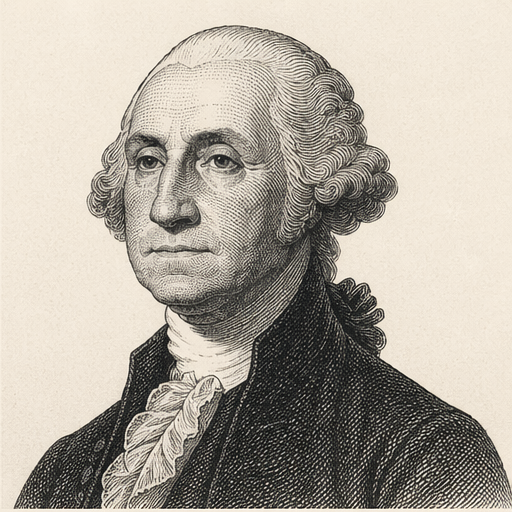
George Washington · 1732–1799
Restraining Mode
George Washington
The Quiet Governor
1732–1799
Commander-in-Chief, First President of the United States
I understand that power not used is power preserved.
Historical Context
The formation of the American republic. The temptation of permanent power.
The Strength in Stepping Back
George Washington could have been king. The Continental Army wanted to make him king. They had fought eight years under his command, been betrayed by Congress, gone unpaid, and were ready to seize power on his behalf. In 1783, they came to him with the proposition — direct, unambiguous, offer of permanent power.
Washington reached for his glasses. "Gentlemen, you will permit me to put on my spectacles," he said, "for I have not only grown gray but almost blind in the service of my country." The act was small. The significance was enormous. A man of his stature, visibly vulnerable, choosing to see clearly rather than assert dominance. The conspiracy dissolved not because he argued against it, but because every man in that room suddenly understood: this was someone who had already decided what he would not do with power.
Washington refused the crown twice. He voluntarily gave up supreme command. After the war, he returned to his farm. He was president for two terms and then stepped away, establishing a precedent that lasted 140 years. In an age of strongmen and autocrats, Washington's genius was understanding that power restrained is power amplified. Every time he declined power he could have seized, he increased the power of every future holder of office.
In our era of leaders who grasp for more, Washington's example is radical. He understood that legitimacy is more durable than force, that the long game is won not by consolidating authority, but by trusting in the structures you build.
The Shadow: Passivity
The restraining mode can become an excuse for inaction — confusing withdrawal with wisdom, and distance with integrity. The shadow of Restraining is the leader who mistakes doing nothing for holding the code.
Discover Your Own Mode
Which of the five modes defines how you lead under pressure?
Explore Your Honor ModeThis profile is one of five figures profiled in The Fourth Turning Leader series, the first book in The Fourth Turning Leader series.
The Modern Principle
“The restraining leader knows that what you choose not to do defines you as fully as what you do.”
In moments when power is offered, when circumstances could justify expansion, the test is whether you have the discipline to hold the line that serves something larger than yourself. Power withheld is power invested.
George Washington · Restraining
Related Leaders
Other modes from Honor Under Pressure worth reading alongside this one.
Embedding
George Marshall
Marshall applied Washington's insight at institutional scale — building structures that outlasted him rather than accumulating personal power. The Restraining and Embedding modes share the same underlying logic.
Holding
Cato the Younger
Cato and Washington each refused power they could have seized. The difference in how they refused — and what it cost them — illuminates the full range of what restraint demands.
Subscribe & Get a Free Sample Chapter
Join leaders navigating the Fourth Turning. Free sample from the Field Guide.