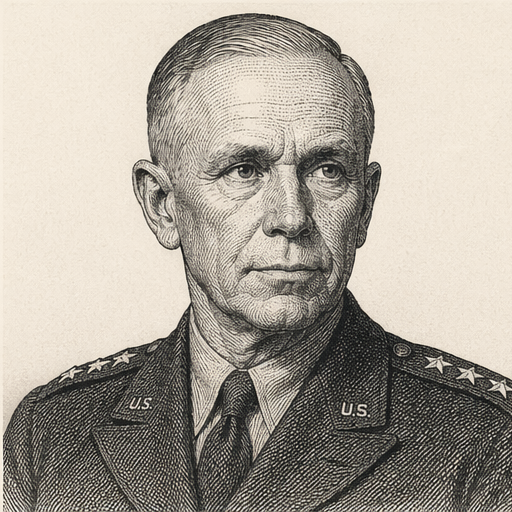
George Marshall · 1880–1959
Embedding Mode
George Marshall
The Institutional Architect
1880–1959
U.S. Army Chief of Staff, Secretary of State, Secretary of Defense
I build systems that outlast me.
Historical Context
World War II and its aftermath. The construction of the postwar world order.
Building What Outlasts You
George Marshall never commanded troops in battle. He commanded the systems that made victory possible. As Army Chief of Staff during World War II, he built the organizational machinery that coordinated millions of soldiers across two continents. He resisted the pressure to take the supreme command in Europe — gave it to Eisenhower instead — because he believed his work was architectural, not tactical.
After the war, Marshall moved to the State Department. His work there was equally architectural. The Marshall Plan was not charity. It was a design for European recovery that prevented the spread of communism, rebuilt shattered economies, and created the framework for stability that lasted a generation. The plan carried his name not because it was popular or easy, but because it embodied a principle: build something that will work when I am gone.
When Marshall was Secretary of Defense during the Korean War, he applied the same logic. Organize the response in a way that creates durable institutions. Embed the principle into the structure. The test of leadership, Marshall believed, was not what you accomplished while you held the position, but what continued working after you left.
Marshall retired from public service and gave his name to the cause of peace. He was asked to oversee civil rights efforts. He built institutions. Always, his question was the same: what will remain? What structure can carry forward the principle without requiring my continued presence? His legacy was not a moment of triumph, but a generation of institutions that outlived him and embodied his values.
The Shadow: Institutionalizing the Wrong Thing
The embedding mode is only as good as what it embeds. A system that outlasts you can outlast your wisdom. Marshall's shadow is the leader who builds durable structures around flawed assumptions — and those structures prove harder to dismantle than the leader ever intended.
Discover Your Own Mode
Which of the five modes defines how you lead under pressure?
Explore Your Honor ModeThis profile is the capstone of the honor code built in The Fourth Turning Leader, the first book in The Fourth Turning Leader series.
The Modern Principle
“The Embedding leader measures success by what survives their departure.”
Personal honor is necessary but insufficient. The leader's highest work is to build structures that carry the principle forward without requiring continued presence. The test is always: what happens when I leave? What survives? What principle is woven into the architecture?
George Marshall · Embedding
Related Leaders
Other modes from Honor Under Pressure worth reading alongside this one.
Restraining
George Washington
Washington's voluntary restraint made the American experiment structurally possible. Marshall extended that logic across two world wars — building institutions, not monuments to himself.
Growing
Abraham Lincoln
Lincoln grew into the right leader for a singular moment. Marshall built so no single moment would require that kind of individual transformation again. One personified honor; the other embedded it.
Subscribe & Get a Free Sample Chapter
Join leaders navigating the Fourth Turning. Free sample from the Field Guide.