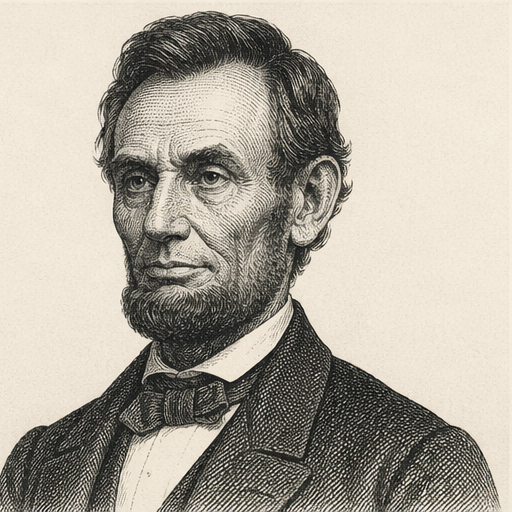
Abraham Lincoln · 1809–1865
Growing Mode
Abraham Lincoln
The Moral Reckoner
1809–1865
16th President of the United States
Crisis is transforming me into something harder and clearer.
Historical Context
The Civil War. The fracture of the American experiment.
Becoming Remade by the Crisis
The Lincoln who entered the presidency in 1861 was not the Lincoln who emancipated enslaved people in 1863. He arrived as a moderate, a pragmatist, a man who had written that he had "no purpose directly or indirectly to interfere with the institution of slavery." He believed in gradualism, in working within the possible, in accepting the constraints of political reality.
The Civil War remade him. Year by year — each battle, each casualty list, each letter to a grieving mother — pushed him toward harder truths. He came to see slavery not as a political inconvenience but as a moral evil that the war itself was forcing to the surface. He came to understand that sometimes the only way to save the Union was to transform what the Union stood for.
The Emancipation Proclamation was not a reversal of principle. It was the act of a man who had grown into clearer principle. Lincoln did not resist the remade version of himself. He used it. He let his understanding evolve. He asked better questions. He became willing to be wrong about where he started.
This was not weakness or inconsistency. It was growth under pressure — the rarest kind of leadership. Most leaders enter a crisis defending the position they came with. Lincoln entered it asking what the crisis would teach him. By the end, he was not the same man. The war had transformed him into something harder, clearer, more morally awake. He called it "a new birth of freedom" — and he meant it had birthed a new version of himself.
The Shadow: Drift
The growing mode, without a fixed code beneath it, can become adaptation without principle — changing not because of moral clarity, but because of pressure. The shadow of Growing is the leader who mistakes movement for development.
Discover Your Own Mode
Which of the five modes defines how you lead under pressure?
Explore Your Honor ModeThis profile is at the center of the leadership framework in Honor Under Pressure, the first book in The Fourth Turning Leader series.
The Modern Principle
“Crisis is a curriculum for those willing to be remade.”
The Growing leader does not resist what the crisis reveals about them. They use it. Growth under pressure is only possible if you are willing to be wrong about where you began — to let experience accumulate into clarity, to become someone who knows more than the person who arrived.
Abraham Lincoln · Growing
Related Leaders
Other modes from Honor Under Pressure worth reading alongside this one.
Eroding
Seneca
Seneca's honest ledger of compromise is the shadow of Lincoln's growth. Both men changed under pressure — Lincoln toward clarity, Seneca toward entanglement. The distinction matters.
Embedding
George Marshall
Lincoln remade himself in the crisis; Marshall built systems so the crisis wouldn't require another Lincoln. The Growing and Embedding modes are two ways of answering the same question.
Subscribe & Get a Free Sample Chapter
Join leaders navigating the Fourth Turning. Free sample from the Field Guide.