Leader Lab · Leadership for the crisis era
The facts are incomplete.
The call is still yours.
When trust, authority, and continuity are at stake, the decision needs more than a quick answer. Use Leader Lab to test your reasoning, build the code behind your call, and leave with a written decision and next action.
A first call. New information. A brief to keep.
Free fictional rehearsal · no account required.
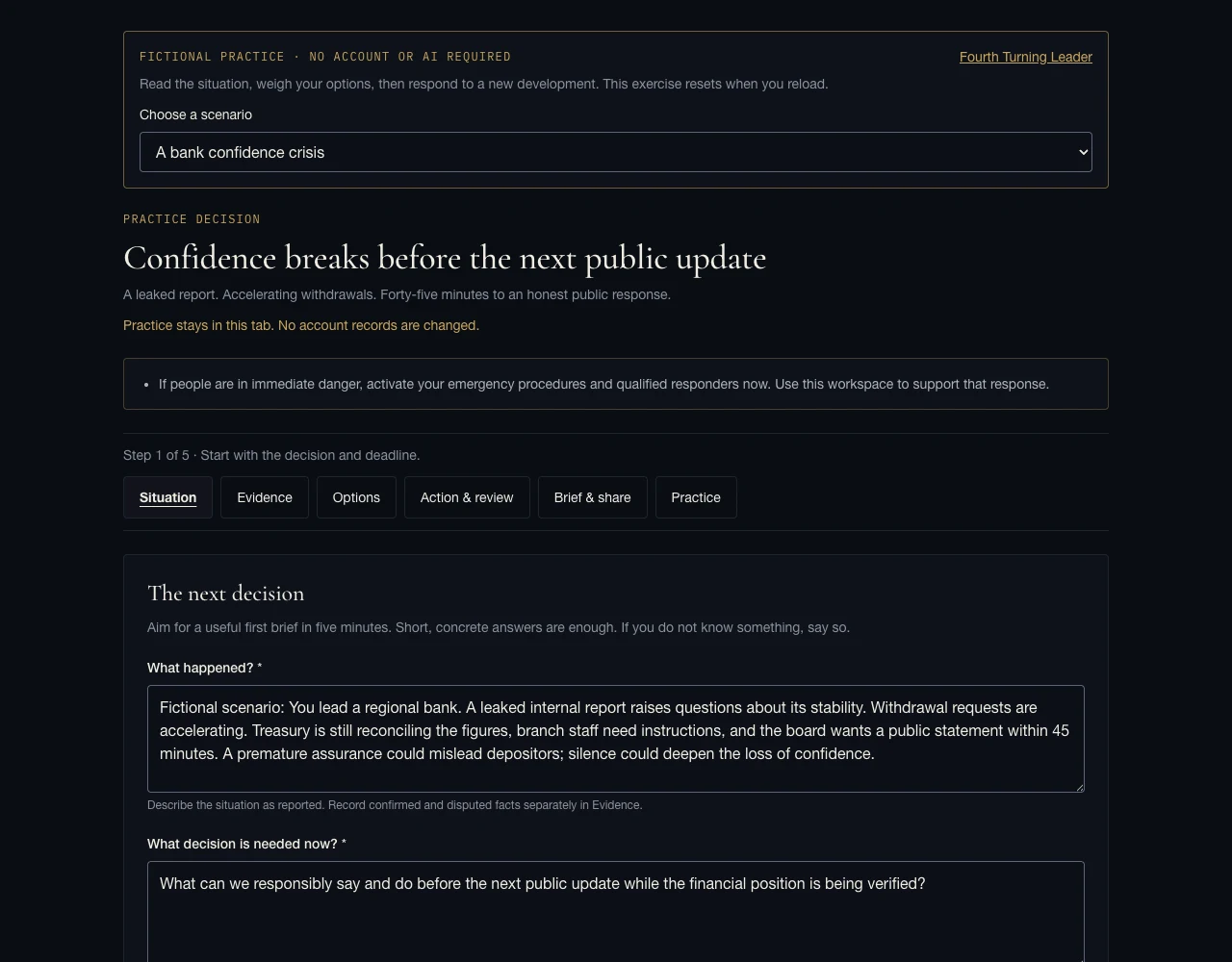
Fictional bank confidence crisis
45 minutes.
Trust is on the line.
A leaked report is spreading. Withdrawals are reportedly accelerating. Treasury is still reconciling the figures. You have 45 minutes before the bank’s public statement.
- Confirmed
- An internal report is circulating publicly.
- Reported
- Withdrawals are above normal; totals are unreconciled.
- Your task
- Decide what the bank should tell depositors before the deadline.
A fictional scenario showing the kind of work you build. The rehearsal itself is untimed.
What leadership in the crisis era demands
The pressure lasts longer than the emergency.
By crisis era, we mean a sustained period of strained institutions, contested authority, and repeated disruption. Your people still need standards they can trust and decisions they can act on.
Build your code before pressure arrives. Put it to work in the hard call. Return to examine what happened and prepare the people who will carry the work forward.
Trust
What can you honestly promise?
A cyber disruption shuts down service. Customers need an answer before the full damage is known.
Standards
What must hold as the work changes?
AI reshapes roles and responsibilities. Your team needs clear limits, fair expectations, and someone accountable.
Continuity
Who can carry the responsibility?
A leader leaves without warning. Decisions cannot wait for everyone to agree on who has authority.
Read a finished example
A call you can
explain and review.
Depositors need answers while the figures are still being verified. Read one possible response, the code behind it, and the leadership pattern to watch.
Fictional bank confidence crisis
Your own work begins with the facts of your decision. The Lab provides prompts, saved drafts, and exports; you supply the judgment.
Decision memo
Illustrative example- The call
- Acknowledge the uncertainty. State only what has been verified, name who is checking the figures, and commit to a timed update.
- The trade
- Candor may accelerate withdrawals. Waiting leaves depositors without guidance. Unsupported reassurance could destroy trust if the figures contradict it.
- Owner and review
- Treasury lead: verify figures before the statement. Communications lead: give branches the approved wording. CEO: issue the statement within 45 minutes and review again in one hour, or sooner if the evidence changes.
Read the evidence and reasoning
- The decision
- A leaked report is spreading. Withdrawals are reportedly accelerating. Treasury is still reconciling the figures. You have 45 minutes before the bank’s public statement. What can we responsibly tell depositors now?
- People at risk
- Depositors need access to savings. Local employers need to meet payroll. Employees need instructions they can trust.
- Evidence
- Confirmed: an internal report is circulating publicly. Reported: withdrawals are above normal, with totals still unreconciled. Unknown: the current financial position and whether the report is current.
- Options
- Offer broad reassurance now; wait for reconciled figures; or acknowledge the uncertainty with verified facts and a specific next update.
- Code check
- The Line rules out unsupported assurances. The Restraint protects staff from repeating claims they cannot verify.
Honor. Culture. Command.
Build the commitments
behind the next call.
Crisis-era leadership begins with your own conduct, reaches the people who depend on you, and shapes the institution they will inherit. Use the three labs to build the code, standards, and continuity that hold those responsibilities together.
You
The Honor Lab
Write the commitments that guide your decisions. Watch where your default under pressure can fail you, and return to the record to see whether your code held.
Your organization
The Culture Lab
Define the standards your organization keeps when pressure rises. Work through contested decisions, invite dissent, and record exceptions in the Culture Registry.
Your institution
The Command Lab
Work through questions of authority, legitimacy, and continuity. Name successors and commitments, and deliberately publish an institutional record when you are ready.
Explore the six Honor Lab tools
Mode Finder
A profile of the leadership patterns your answers suggest under pressure.
Shadow Audit
A watchlist of where a strength can become a liability.
Honor Code Builder
Five written commitments: your line, restraint, test, growing edge, and transmission.
Decision Room
A memo that records the options, the cost, and the call you can explain.
Endurance Ledger
A review of how your code holds over time. Five entries open a pattern report.
Transmission Plan
Named successors and the judgment you want them to carry forward.
Work at your own pace. You can work on decisions and export individual documents before completing your full Code Packet.
Return to the decision with a record of your work
Your saved cases, owned actions, and outcome reviews give you a place to resume. The Endurance Ledger and Midnight Test support ongoing reflection; Field Notes and the AI companion help you examine the reasoning.
Fictional case · Geopolitical supply disruption
The crisis changes. Your responsibility continues.
A manufacturer supplies parts that keep water systems and factories running. A regional conflict cuts its supply route. Follow one decision through new evidence and a later review.
Monday, 9 a.m. · The first call
Three days of stock. Three hours to give an answer.
The carrier confirms shipments are suspended. A reopening date is unverified. The board expects a plan by noon; customers need parts and employees need to know whether shifts will be cut.
The strongest objection
Reserving stock for water utilities could leave factories idle and put other people’s jobs at risk.
The decision record
- The call
- Disclose the limits. Reserve stock for verified essential-service needs while checking alternatives. Give customers and employees an update by noon, without promising uninterrupted supply.
- Who acts next
- Operations: verify stock and needs. CEO: explain the call.
- When to return
- Noon today, then Tuesday at 9 a.m.; sooner if supply is confirmed.
Keep the evidence, the obligations in conflict, and the cost of your call together.
Tuesday, 9 a.m. · New evidence
Supply is available. Buying it all puts payroll at risk.
The board authorizes emergency spending through Friday. A backup confirms Thursday delivery, at a premium with payment upfront. Buying the full quantity would consume part of the payroll reserve.
The strongest objection
Protecting payroll could leave a utility without a critical part. Who carries that risk?
The decision record
- The call
- Approve only the quantity that preserves payroll. Allocate by verified consequences of interruption. Explain the criteria, record exceptions, and name who may authorize them.
- Who acts next
- CFO: confirm the spending limit. Operations: apply the allocation.
- When to return
- Thursday on receipt; immediately if delivery or cash assumptions fail.
Return to the same case. Record what changed, what held, and why.
Friday · Outcome review
Essential orders shipped. The crisis has not ended.
In this example, the backup arrived and critical orders shipped. Two industrial customers still lack parts. Payroll is protected, but some factory shifts are canceled. The original route remains closed.
The strongest objection
An emergency allocation can become an unexamined rule. Temporary authority needs a limit.
The decision record
- The call
- Review allocations daily. Require the board to renew emergency spending authority before Monday. Name a deputy who can act if the CEO is unavailable.
- Who acts next
- CEO and board chair: review the limits and handoff.
- When to return
- Monday before purchasing; sooner if essential services face a new risk.
Record the consequences, unfinished obligations, and next review. Keep responsibility visible.
Illustrative walkthrough of a fictional crisis, not an app screenshot, playable scenario, or customer result.
The three labs help you build the commitments behind calls like this.
- HonorWhat must hold?
- Tell the truth about shortages and the costs of your choice.
- CultureWhat can others apply?
- Allocate by explicit standards, with room to challenge exceptions.
- CommandWho has authority?
- Limit emergency powers and prepare someone else to carry the decision.
Your practice for the crisis era
For the decision you carry.
And the ones after it.
A self-guided app for leadership in the crisis era. Work through the decisions that test your principles, your people, and the institution you lead.
- Work the decision
- Bring a real decision. Separate facts from assumptions, test the options, and record a call with an owner and a review point.
- Build the code behind it
- Use the Honor, Culture, and Command Labs to examine the commitments you will hold, the standards others can use, and the limits of your authority.
- Return and follow through
- Reopen the same case when facts change. Keep earlier reasoning, record the outcome, and apply what you learn to the next decision.
Try the method. Then use it.
Start with a rehearsal.
Return to your own work.
The free scenario shows the practice. Paid access gives your decisions a place to continue.
| Your work | Free rehearsal | Leader Lab · $495 once |
|---|---|---|
| The situation | A fictional crisis with a new development | Your own decisions and evidence |
| The takeaway | Your rehearsal brief, available to download | Decision briefs, codes, and the documents you build and export |
| Follow-through | Try the steps without an account | Save cases, return to owned actions, and review outcomes |
| The wider practice | A sample of the crisis workspace | All three labs, Field Notes, an AI companion, and a printed Field Guide on request for U.S. delivery |
Privacy and AI processing before you bring a real decision
Personal drafts are private within the Lab by default. Institutional publishing is deliberate. Ask Chris sends your messages and relevant saved work to Delphi; requested AI analysis uses Anthropic. Use information you are authorized to share. Read how your work is processed
See the full crisis workspace
Your first session
Start with one real decision.
A disruption threatening service. An AI rollout changing who is accountable. A sudden leadership departure. Bring the decision you need to make and leave with a written call and next action.
No assessment or completed code required first. Work at your own pace.
Bring the decision already on your desk.
Name the call you need to make, who it affects, and what you know. Start directly in the crisis workspace.
Put your reasoning to work.
Compare the options and their costs. Name the strongest objection, then record the decision you are prepared to own.
Give the decision a next step.
Assign an action owner, set a review point, and name the evidence that would make you reconsider. Save or export your brief.
The value continues after the call.
Return to the same case when the facts change. At your review point, record what happened, compare it with what you expected, and carry the lesson into the next decision.
Start with one decision