A plain-English guide
The Fourth Turning,
explained.
Understand the era. Prepare to lead through it.
The Fourth Turning is the crisis phase of the generational cycle proposed by William Strauss and Neil Howe. In their model, a roughly 80- to 100-year cycle ends in about two decades of upheaval, when institutions face breakdown and renewal.
Free rehearsal · No account · A decision brief to keep
Read the video transcript
When institutions lose the trust of their people, who earns the authority to build what comes next?
That is the leadership question at the heart of the Fourth Turning.
William Strauss and Neil Howe proposed that Anglo-American history moves through four generational seasons: a High, an Awakening, an Unraveling, and a Crisis.
In their model, the cycle takes roughly eighty to a hundred years. The Fourth Turning is the crisis: accumulated failures force a society to confront what it will preserve, what it will abandon, and what it will build.
The American Revolution. The Civil War. The Depression and World War Two. These are the authors’ historical examples.
I take the pattern seriously. I also test it against evidence. A theory can sharpen our judgment. It cannot make our decisions.
I’m Chris Myers. I lead B:Side Capital, teach entrepreneurship, and wrote Honor Under Pressure to explore the choices leadership demands.
My view is that renewal has to be earned. The institutions that emerge will reflect the choices people make under pressure.
Consider a fictional bank confidence crisis. You have forty-five minutes before a public statement. The numbers are incomplete. People’s savings and livelihoods are at stake.
What can you truthfully say? Whose interests will you protect? What limits will you place on your own power?
Your answers become the institution people have to live with.
That is the work of a Fourth Turning leader: practice judgment, exercise restraint, and build something others can depend on.
Join my free email list below for my essays on institutional trust, leadership under pressure, and building what comes next.
The storm is already here. Build anyway.
In this guide
Start here
What is the Fourth Turning?
A “turning” means a broad change in the mood and organization of society. The “fourth” is the last of four phases. Strauss and Howe compare it to winter: a difficult period when arrangements that once seemed dependable can no longer handle the pressures on them.
Here, institutions means the systems people rely on: government, banks, courts, schools, businesses, and civic organizations. A crisis of institutions is also a crisis of trust. People begin asking who can make decisions, whose interests the rules protect, and whether those rules still deserve support.
The authors developed their generational account in Generations (1991) and The Fourth Turning (1997). Their central claim concerns recurring patterns in Anglo-American history. It is an interpretation of how societies change, not a universal law that every country follows.
An era, not an event
A recession, an election, or a war is an event within history. A Fourth Turning, in this theory, is the wider period in which several upheavals reshape the institutions people live under.
Sources: William Strauss and Neil Howe, The Fourth Turning (1997); Neil Howe on The Art of Manliness, episode 913 (2023).
The cycle at a glance
What are the four turnings?
Each turning lasts roughly a generation. This timeline shows Howe’s interpretation of the United States since World War II. The boundaries are approximate.
- First Turning · Spring
The High
Postwar–mid-1960s
Institutions gain confidence after a crisis. People place more faith in collective projects and a shared social order.
The postwar United States.
- Second Turning · Summer
The Awakening
Mid-1960s–mid-1980s
People challenge the established order and seek greater personal freedom, meaning, and authenticity.
The cultural upheavals of the 1960s and 1970s.
- Third Turning · Autumn
The Unraveling
Mid-1980s–2008
Individualism strengthens while trust in institutions weakens. Agreement about shared rules becomes harder.
The culture wars and growing political fragmentation.
- Fourth Turning · Winter
The Crisis
2008 onward, in Howe’s account
Major failures force a struggle over how society will function. Institutions may be replaced or rebuilt.
The era Howe traces from the financial crisis.
Sources: Neil Howe on The Art of Manliness, episode 913 (2023).
The historical comparison
What were the previous Fourth Turnings?
The authors use these American crises to illustrate their argument. The events are historical; classifying them as repetitions of one cycle is the authors’ interpretation.
- American RevolutionLate 18th century
- The colonies broke with Britain and built a new constitutional order. The change concerned the source and limits of political authority, as well as independence.
- American Civil War1860s
- The Union survived and slavery was abolished. Reconstruction exposed the continuing conflict over citizenship, rights, and who could exercise power.
- Great Depression and World War II1929–1945
- Economic collapse and global war reshaped the federal government’s responsibilities, the economy, and America’s international role.
These episodes had different causes and consequences. Their common feature is a struggle over the rules of public life. Rebuilding institutions did not remove injustice or settle every conflict.
Sources: William Strauss and Neil Howe, The Fourth Turning (1997); Neil Howe, The Fourth Turning Is Here (2023).
How the model works
Why do generations matter?
The proposed link is between historical experience and generational memory. A child who grows up during a crisis encounters a different world from someone raised during a period of confidence. As generations age, their experiences may shape what they expect from institutions and what they are willing to change.
Strauss and Howe argue that these differences reinforce one another over a long cycle, which they call a saeculum: roughly the span of a long human life. A turning is an era shared by people of all ages; a generation is a group born around the same time. They are related concepts, not interchangeable terms.
Their four recurring generational types are called Prophet, Nomad, Hero, and Artist. These are roles within the theory, not personality tests or verdicts on an individual. Sharing a birth year does not mean sharing a character, a politics, or a destiny.
Sources: William Strauss and Neil Howe, The Fourth Turning (1997).
The present and the forecast
Where are we in the cycle?
Are we in a Fourth Turning now?
In Neil Howe’s interpretation, yes. He identifies the financial crisis around 2008 as the opening catalyst. His 2023 book, The Fourth Turning Is Here, places the United States within that Crisis era. This is Howe’s reading of events, rather than an agreed historical classification.
When will the Fourth Turning end?
There is no established end date. Howe’s 2023 forecast points toward a climax in the early 2030s. A forecast of a climax is not a promise that every conflict will be resolved by a particular year. In the model, the decisive change is the establishment of a new civic order.
What happens after a Fourth Turning?
The model moves into another High, with stronger institutions and renewed confidence. That does not guarantee a fair or peaceful outcome. A society can become more organized while restricting freedom or excluding people. The character of the new order matters as much as its stability.
Sources: Neil Howe, The Fourth Turning Is Here (2023); Neil Howe on The Art of Manliness, episode 913 (2023).
From understanding the era to leading through it
When the old answers stop working, what will people be able to count on you for?
A crisis era reaches your organization through the decisions people need you to make. Trust depends on what you can honestly promise. Standards matter when familiar rules no longer settle the question. Authority needs limits, an accountable owner, and someone prepared to carry it forward. You can begin with the call in front of you, before certainty arrives or everyone agrees.
Begin here · Fictional bank confidence crisis
The facts are incomplete. What will you tell people?
You are the CEO. A leaked report is spreading, withdrawal totals are unverified, and a public statement is due in 45 minutes. Depositors need answers. Local employers need to meet payroll.
The setting is a bank. The responsibility belongs to anyone leading people through uncertainty: tell the truth, weigh the cost, and own what happens next.
In the rehearsal, add your reasoning, face new information, and build your brief.
Free · No account · Four untimed steps. The 45-minute deadline is fictional.
Example decision brief
A call. An owner. A reason to reconsider.
- Next action
- Verify the current figures and give Communications a list of supported claims before the public statement.Owner: Treasury lead · Review in 30 minutes.
See the call and review trigger
- Current call
- Keep the bounded update. Correct the branch assurance explicitly, verify whether the report is outdated, and give staff wording that separates confirmed facts from unresolved totals. Do not punish the correction or hide its cause.
- Reopen if
- Verified figures contradict the statement, or withdrawal requests materially exceed the current estimate.
A completed fictional example. Your choice does not generate this brief.
Read the full example briefBring your own decisionPaid workspace · $495 onceRead with judgment
Is the Fourth Turning theory reliable?
It can prompt useful questions about history. It should not be treated as a proven forecasting system.
Four cautions matter when deciding how much weight to give the theory:
A pattern is not proof of a fixed cycle.
Identifying crises in the past does not establish that the next one must arrive on schedule. Ask which events do not fit and whether a different choice of dates would change the pattern.
Generations contain very different lives.
Age, income, race, geography, and shared events can influence attitudes. Pew Research Center explains why generational comparisons need to distinguish those factors and avoid stereotypes. Its guidance concerns generational research broadly; it is not a direct test of the Fourth Turning theory.
The historical scope is limited.
An account built around Anglo-American history should not automatically be applied to every society. Countries have different institutions, conflicts, and timelines.
The story can encourage fatalism.
If every alarming headline becomes confirmation, the theory stops being something you can question. Neither war nor renewal should be treated as a permission slip: people remain responsible for the choices they make.
Sources: Pew Research Center: How we plan to report on generations (2023).
A practical takeaway
How can you use the idea?
You do not have to accept a historical cycle to take institutional trust seriously. When you hear a sweeping prediction, separate the observed event from the explanation attached to it. “A bank failed” and “the entire system is destined to collapse” are very different claims.
Look for specific evidence: who is accountable, which services people depend on, what is known, and what would change the assessment. Talk to people with relevant knowledge and people who disagree with you. A useful historical framework should make your questions better, not make you certain before you have the facts.
Useful questions are concrete: What is failing? Who depends on it? What could repair it? What evidence would make me reconsider?
Five questions for a decision under pressure
- What do we actually know?
- Separate verified facts, reports, and assumptions. Name the missing fact most likely to change your decision.
- Who bears the cost?
- Name the people affected by acting, waiting, or being wrong. Make competing obligations visible.
- What line will we hold?
- State what you will not misrepresent, sacrifice, or excuse to make the pressure go away.
- Who can act, and who can challenge?
- Assign an owner. Set limits on emergency authority and give someone permission to test the reasoning.
- When will we reconsider?
- Set the next update and the evidence that would change the call. Record what you want your successor to understand.
Free PDF. No email required.
Quick answers
Frequently asked questions
What is the Fourth Turning in simple terms?
The Fourth Turning is the crisis phase of the generational cycle proposed by William Strauss and Neil Howe. In their model, a roughly 80- to 100-year cycle ends in about two decades of upheaval, when institutions face breakdown and renewal.
How long does a Fourth Turning last?
In the Strauss–Howe model, a turning typically lasts about 20 to 25 years, within a full cycle of roughly 80 to 100 years. These are approximate spans, not a timer that applies to every historical crisis.
When was the last Fourth Turning?
Strauss and Howe identify the Great Depression and World War II, roughly 1929–1945, as the previous American Crisis era. In their model, the postwar High followed it.
Are we in a Fourth Turning now?
In Neil Howe’s interpretation, yes. He identifies the financial crisis around 2008 as the opening catalyst. His 2023 book, The Fourth Turning Is Here, places the United States within that Crisis era. This is Howe’s reading of events, rather than an agreed historical classification.
When will the Fourth Turning end?
There is no established end date. Howe’s 2023 forecast points toward a climax in the early 2030s. A forecast of a climax is not a promise that every conflict will be resolved by a particular year. In the model, the decisive change is the establishment of a new civic order.
What happens after a Fourth Turning?
The model moves into another High, with stronger institutions and renewed confidence. That does not guarantee a fair or peaceful outcome. A society can become more organized while restricting freedom or excluding people. The character of the new order matters as much as its stability.
Does a Fourth Turning mean war is inevitable?
No historical theory can establish that a future war is inevitable. War is central to the authors’ historical examples, but those examples do not determine what people and governments will choose next.
Is the Fourth Turning theory proven?
It is not established as a reliable predictive law. Treat the Fourth Turning as an interpretation of history. The dates are approximate, and its predictions remain uncertain. It cannot tell you whether a particular bank will fail, a conflict will escalate, or a technology will overturn your organization. Decisions still require current evidence, relevant expertise, and people willing to challenge your assumptions.
Is the Fourth Turning the same as the Fourth Industrial Revolution?
No. The Fourth Turning concerns a proposed cycle of generational and institutional change. The Fourth Industrial Revolution concerns changes associated with technologies such as AI, robotics, and connected systems. The similar names refer to different ideas.
Which book explains the original theory?
Start with The Fourth Turning (1997) by William Strauss and Neil Howe. Generations (1991) sets out their earlier generational account; The Fourth Turning Is Here (2023) gives Howe’s updated interpretation. Christopher Myers’s Honor Under Pressure is a separate book about leadership and judgment in the crisis era.
Check the argument
Sources & further reading
The books and interviews explain the authors’ claims. The research guidance helps evaluate generational claims.
- William Strauss and Neil Howe, The Fourth Turning (1997)
The original book develops the four-stage framework and historical argument.
- Neil Howe, The Fourth Turning Is Here (2023)
Howe’s updated argument and forecast. The early-2030s timing is a prediction from this account.
- Neil Howe on The Art of Manliness, episode 913 (2023)
Howe explains the 2008 catalyst, the difference between an event and an era, and possible outcomes.
- Pew Research Center: How we plan to report on generations (2023)
Research guidance on age, historical context, and the limits of generational labels.

Your practice for the crisis era
The next call will be yours.
The free rehearsal gives you a place to practice. Leader Lab gives you a workspace for the decisions your own people depend on, and a record you can return to when the facts change.
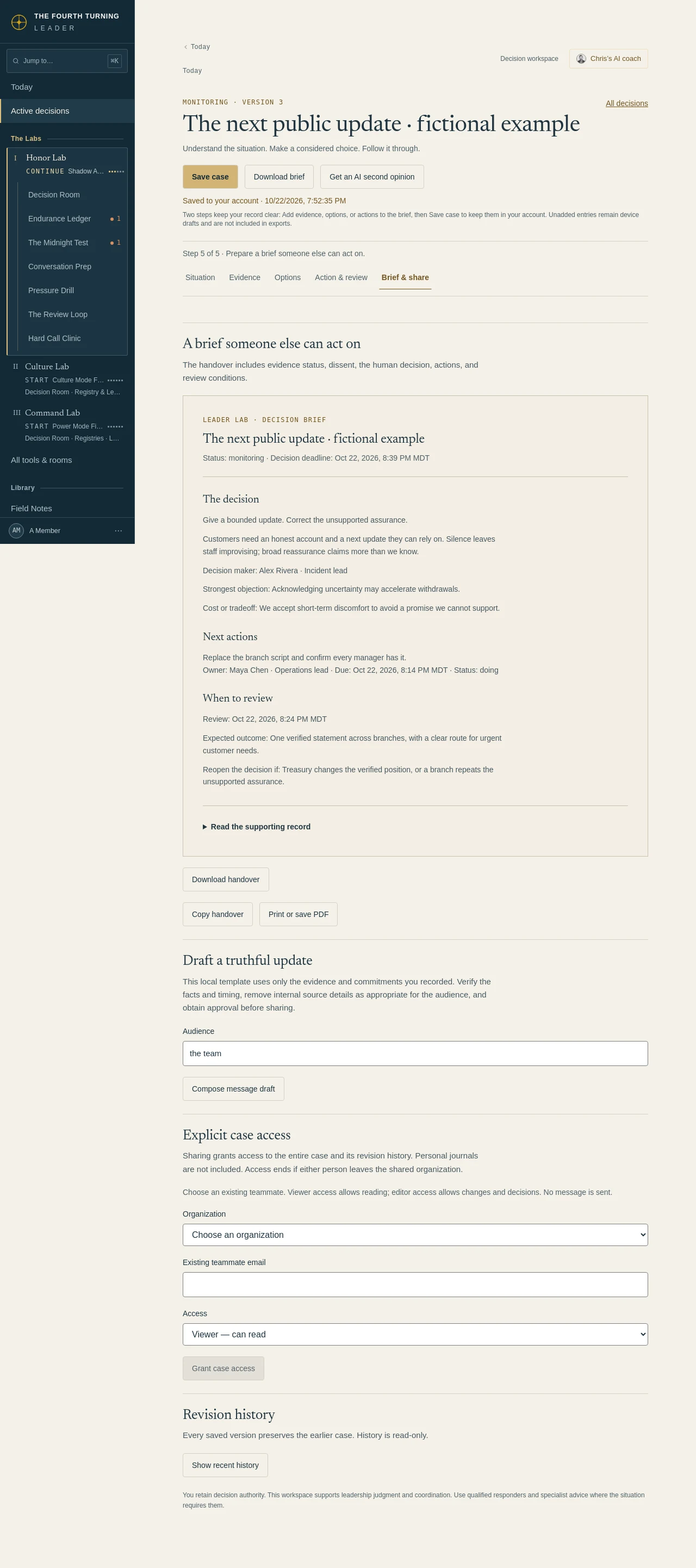
Make the call
Save your decision and the reasoning behind it.
Name the owner
Give the next action an accountable owner.
Know when to reopen it
Record what would make you reconsider.
- Honor
- Build the commitments you will hold when keeping them becomes costly.
- Culture
- Set standards your people can use, with room to question the call.
- Command
- Examine the limits of your authority and prepare others to carry responsibility.
Keep thinking with me
Understand the era.
Meet it with judgment.
Get Chris’s free essays on institutional trust, leadership under pressure, and building what comes next.
Keep exploring
From understanding to responsibility
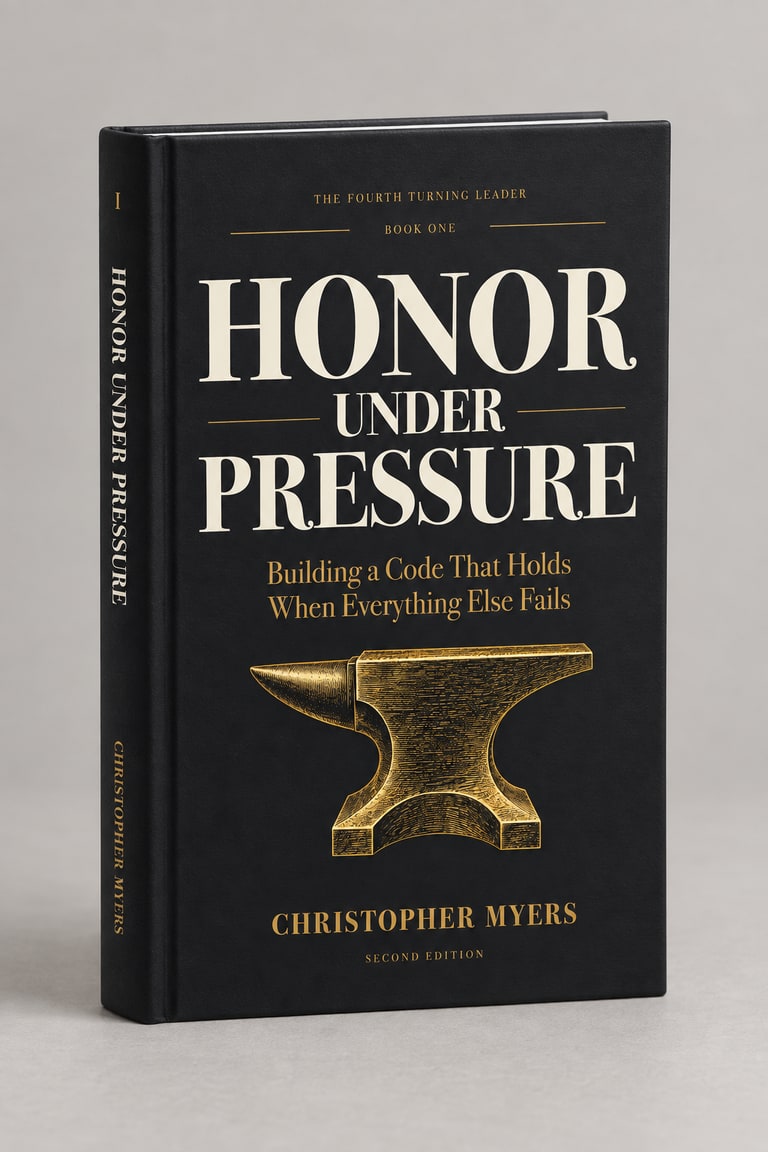
The book behind the practice
Read Honor Under Pressure
Build the commitments you will hold when others depend on your decisions. The book develops the argument; Leader Lab gives you a place to put it to work. You can begin with either.
Explore the bookTrust and legitimacy
How Leaders Build Moral Authority Under Pressure
How to earn trust when duties conflict: apply standards to powerful people, preserve dissent, and record the reasoning behind decisions others must live with.
Read the essayDecisions and accountability
Board Decisions During a Crisis Must Hold
A practical guide to crisis governance: clarify who can act, distinguish facts from assumptions, protect dissent, and set triggers for reviewing consequential decisions.
Read the essayMore Fourth Turning essays and resources
Go one level deeper
Articles in this cluster
From the Dispatch
- Fourth Turning Cycles and the Burden of CommandFourth Turning cycles test leaders when institutions fail. Learn how to build decision records, protect legitimacy, and act before consensus forms at all.
- Fourth Turning Leadership Guide for CEOsA Fourth Turning leadership guide for CEOs who must make defensible decisions, build durable institutions, and act before consensus arrives under pressure.
- What Is the Fourth Turning? A Leader's TestWhat is the Fourth Turning? Learn the historical cycle theory, its limits, and what leaders must do when institutions lose authority and fail publicly.
- The Strongman AuditionEvery Fourth Turning ends with strengthened authority. The only open question is its character.
- The Diagnosis Was Never EnoughOn what comes after naming the storm
- The Invisible ArchitectureEvery system you interact with was designed to solve a problem that no longer exists
- Playbooks Over Panic: Writing Your Unexpected Events ManualWhy a living document beats winging it every time
- Read Not the Times. Read the Eternities.Why stepping away from the noise might be the clearest move a leader can make
- The Crisis EraWhat It Means, Where We're Headed, and Why It Matters Now
- Building Mental ToughnessHow To Develop The Strength to Endure and Adapt
- The Freedom TrapWhen More Options Lead to Less Satisfaction
- Shifting the Overton Window in LeadershipHow Bold Ideas Become the New Norm
- Rising to the MomentPreparation Meets Opportunity
- The Path ThroughFacing Obstacles Head-On
- The Strength of SimplicityHow clear, focused leadership builds trust and drives success
- Coaching vs. Management vs. LeadershipThe Bill Campbell Way
- The Transformative Power of Positive ReframingLearning to say “Good”
- Confronting the Dark SideTurning Repression into Strength
- Lessons from Hannibal’s Tactical GeniusThe Value of Adaptability
- Simplicity as a Cultural ValueBuilding a Simple Organization
- Embracing Imperfection in LeadershipLessons from Montaigne
- The Power of Letting GoThe Paradoxical Approach to Unlocking Solutions
- The Power of Doing Your BestA Mother's Day Message That Stuck
- Don't Be a "Pigeon" CEOGrowing Beyond the "Swoop and Poop" Leadership Style
- From Reflection to RenewalAn Easter Season Guide for Leaders Navigating Change
- Empowering ExcellenceStrategies for Leading High Achievers to Success
- Mastering the Art of ChangeLessons in Swift Adaptation
- Compassionate CandorStraightforward Communication for Stronger, More Empathetic Teams
- Safeguarding Your Core Mastering the Center-of-Gravity Strategy
- Avoiding GroupthinkHow to Lead Without Imposing and Encourage Independent Thought
- Talent Recruitment and Retention J. Robert Oppenheimer's Leadership Genius Behind the Manhattan Project
- Navigating the SpotlightHow Subtlety and Restraint Propel Leadership Success
- The Litany Against FearA Leadership Lesson from Dune
- The Art of Strategic Detachment Cultivating Clarity, Resilience, and Focus in a Turbulent World
- Elevating SuccessThe Power of Amplifying Others' Achievements
- Beyond Quick Fixes The Transformative Power of Thoughtful Decision-Making in Leadership
- Breaking the Mold Creative Leadership in Traditional Industries
- Awakening from the Great NapNavigating the Fourth Turning with Resilient Leadership and Disciplined Wisdom
- Empathetic Digital LeadershipNavigating the Human Element in a Technology-Driven Era
- The Art of Giving A DamnTurning Intense Feelings into Creative Power
- White Space ManagementBalancing Energy in Leadership
- Valuing the InsignificantA Leader's Eye for Detail
- Help-Seeking Leadership:The Power of Vulnerability in Feedback